
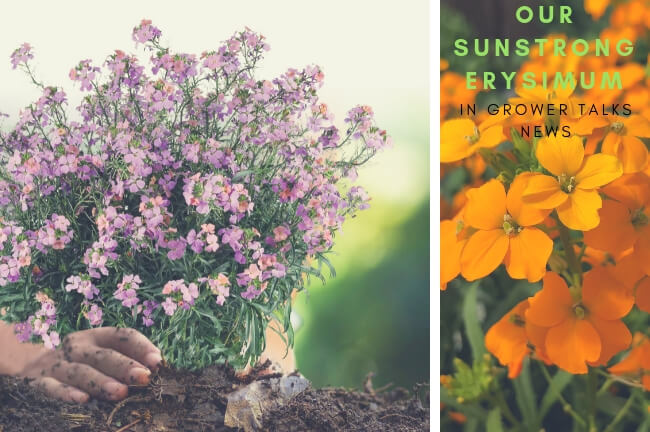
[vc_row css_animation= » » row_type= »row » use_row_as_full_screen_section= »no » type= »full_width » angled_section= »no » text_align= »left » background_image_as_pattern= »without_pattern »][vc_column][vc_column_text]Consumers are looking for easy-to-grow perennials that provide blooms all summer long. Sunstrong™ Erysimum truly delivers on the promise to flower early and throughout the season. In fact, Sunstrong™ is set to change the Erysimum category. In the past, Erysimum was seen only as spring bloomers. Now Sunstrong™ provides blooms all summer long, even in the southern U.S. One of the key differences in Sunstrong’s production is that there’s no cooling needed. Developed in Danziger’s facilities in Israel, Sunstrong™ delivers first year flowering without a cooling period. This gives growers the advantage to grow these perennials in a warm greenhouse, extending the season on either end. The days of reserving spays and moving product during production are over. Sunstrong™ finishes faster and is ready earlier. At Danziger’s facilities in Israel, the weather makes it impossible to provide a cooling period for any perennials. Because of these growing conditions, Sunstrong™, along with the Solanna™ Coreopsis and Lucille™ Leucanthemum series, can all be grown in a warm greenhouse. These varieties offer growers options and flexibility. Even though they don’t need vernalization, they can be produced with a cooling period. Several growers are having great success in traditional perennial growing programs.
Both varieties in the Sunstrong™ series shows exceptional heat tolerance. Sunstrong™ Bicolor Purple features large, lavender blooms. Sunstrong™ Orange offers tangerine-hued flowers with a delicate, fresh scent. A great thriller plant in large containers and stunning in the landscape. Sunstrong™ grows to 14 in. in height.
Additional production tips for Sunstrong™ Erysimum
- Pot size: Quarts or gallons
- pH: Maintain potting mix pH at 6 to 6.5 throughout production.
- Sticking: Stick one liner per cell. Apply Deconil fungicide on the day of sticking. Provide a second Deconil application in week 2.
- Planting: Transplant to one per pot in week 5.
- Temperature: Greenhouse temperatures should be between 72 to74F (22 to 23C) in weeks 1 through 3. Decrease greenhouse temperatures to 65 to 68F (18 to 20C) for week 4, 55 to 60F (12 to 15C) for weeks 5 through weeks 6 to 14.
- Pinching: Pinch once during week 3.
- Fertilization: Begin with 50 ppm nitrogen in a mist for weeks 1 and 2. In week 3, feed 100 to 150 ppm and continue with this rate through a finish at week 14.
- Light: Provide supplemental light through week 5.
- PGRs: Apply B-Nine on week 4 if needed.
- Irrigation: Normal watering program
- Electrical Conductivity: (EC) Should increase slightly throughout the production process. Start with 0.80 in week 1, then increase to 0.90 in week 2. In week 3 through 14, EC should be fairly steady at 1.0 to 1.2.
- Additional disease and pest control: Common disease and pest issues can include botrytis, aphids, and whitefly. Be on the lookout and treat accordingly.
For more articles about our products in Grower Talks magazine click here.[/vc_column_text][vc_empty_space][/vc_column][/vc_row][vc_row css_animation= » » row_type= »row » use_row_as_full_screen_section= »no » type= »full_width » angled_section= »no » text_align= »left » background_image_as_pattern= »without_pattern »][vc_column][vc_gallery type= »image_grid » images= »13100,13785,12416,12816,12817″ column_number= »5″ grayscale= »no » images_space= »gallery_with_space »][vc_empty_space][/vc_column][vc_column][/vc_column][/vc_row]